August’s Jobs Surprise Is Good News for CRE Demand, Pushes Financing Costs Higher
A Strong Jobs Report Creates a Two-Sided Signal for CRE
Hiring is strengthening CRE fundamentals, but higher Treasury yields are keeping the cost of capital elevated.
The labor market is strengthening. The cost of capital is too.
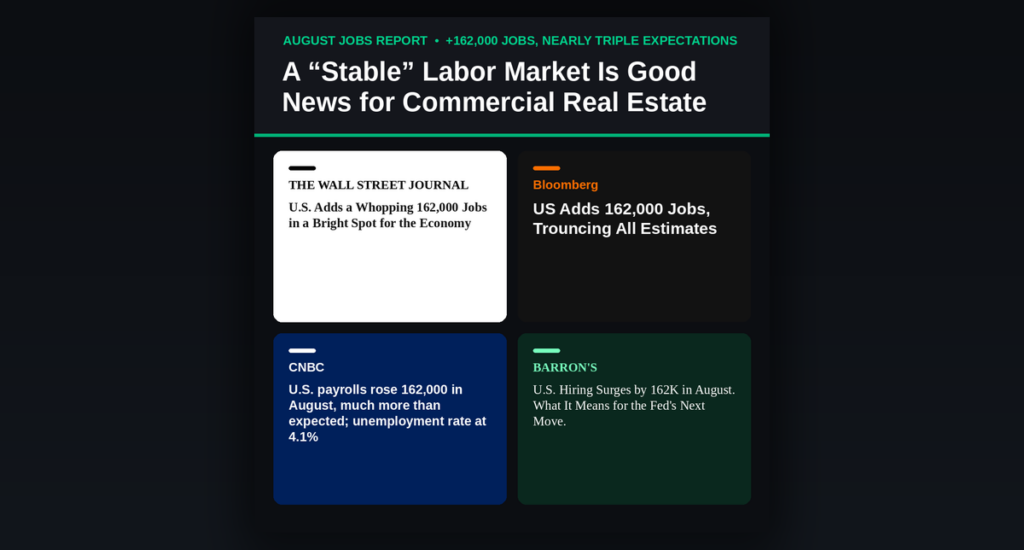
The latest jobs report was a strong signal of broad-based growth across the U.S. economy, and it cuts two ways for commercial real estate.
The U.S. added 162,000 jobs in August, nearly triple expectations, while June and July numbers were revised higher. Unemployment held at 4.1%, and labor force participation ticked up to 61.6%.
What stood out was the range of the gains:
→ Food services and drinking places added roughly 59,000 jobs
→ Manufacturing added 16,000
→ Construction added 22,000
→ Health care, the primary engine of job growth, saw a gain of 13,000
Fed Chair Kevin Warsh recently called the labor market stable and consistent with full employment, a sign the economy has more underlying momentum than many expected.
On the demand side, that growth is a genuine tailwind for CRE:
-
Retail: Strong hiring in food services and drinking places is a direct read on consumer activity, supporting demand for restaurant space, food halls, and mixed-use retail centers.
-
Industrial: Manufacturing and construction gains point to continued demand for industrial and logistics space.
-
Data centers: Continued investment in data centers is supporting demand for specialized industrial infrastructure.
-
Office: Continued health care job growth supports demand for medical office and traditional office space, particularly among health systems and related professional services.
-
Multifamily: A growing, steadily employed workforce supports rental demand, occupancy, and household formation.
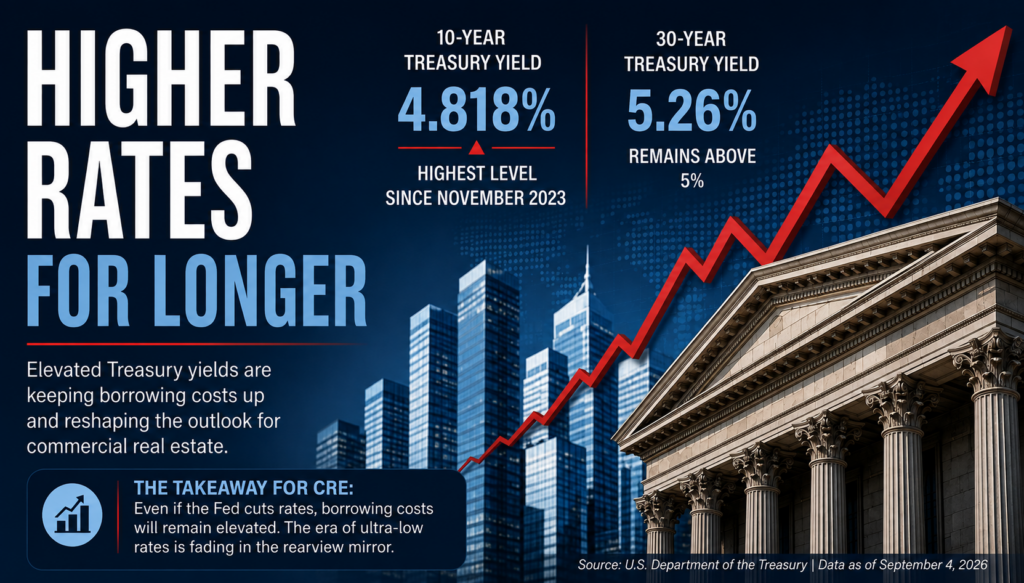
But a stronger labor market cuts the other way on financing. Treasury yields moved higher following the report, with the 10-year reaching 4.82% and the 30-year at 5.26%. Even if the Fed cuts rates, CRE borrowing costs will likely remain elevated. Long-term Treasury yields remain the key benchmark for financing, and the era of ultra-low rates keeps fading further into the rearview mirror.
Put together: fundamentals are strengthening, but so is the cost of capital. Buyers are underwriting to today’s cost of capital, sellers need realistic pricing, and deals are still getting done. Disciplined pricing and strong fundamentals matter more than ever.