CRE Pricing Discipline in a High-Yield Era
Higher Treasury Yields Reshape the Rate Outlook for Commercial Real Estate
The 10-year Treasury just hit a 2025 high, and it may matter more to your deals than the Fed’s next move does.
Job openings rose and layoffs fell, but elevated long-term rates may be the bigger story for commercial real estate
The Federal Reserve may be holding the federal funds rate steady, but the broader interest-rate environment is becoming more complicated.
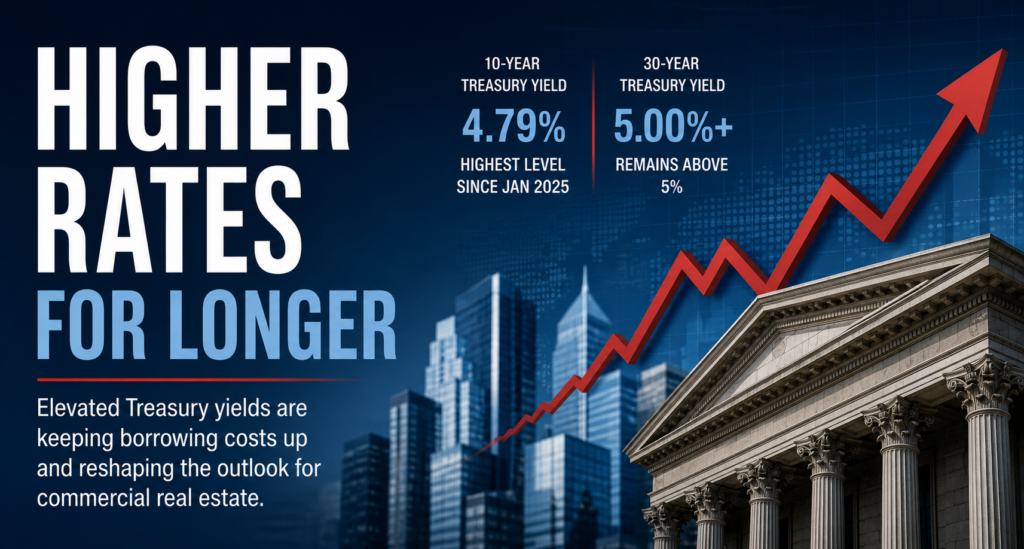
The benchmark 10-year U.S. Treasury yield recently reached 4.79%, its highest level since January 2025, while the 30-year Treasury yield has remained above 5%. The move reflects more than expectations for Federal Reserve policy. Heavy government borrowing, persistent inflation, and growing corporate demand for capital are putting upward pressure on longer-term yields.
That distinction matters for commercial real estate.
The federal funds rate directly influences short-term borrowing costs, but long-term Treasury yields are a more important benchmark for many commercial real estate loans and investment decisions. If Treasury yields remain elevated, the cost of capital can stay higher even if the Fed eventually begins cutting rates.
The Labor Market Is Stable, but Losing Momentum
The latest labor-market data provides a counterpoint to the rise in long-term yields.
U.S. job openings edged higher to 7.27 million in July from a downwardly revised 7.18 million in June, while layoffs fell to their lowest level since January. The data points to a labor market that remains relatively stable, but subdued.
The ratio of job openings to unemployed workers has also moved considerably lower from its 2022 peak, reinforcing the picture of a low-hire, low-fire environment. Employers appear reluctant to significantly expand headcount, but they are also hesitant to make broad layoffs.
That balance complicates the Fed’s next move.
Persistent inflation continues to argue for caution on rate cuts, while softer employment conditions give policymakers less reason to tighten further. With another jobs report and additional inflation data still ahead of the Federal Open Market Committee’s September 16 meeting, the path forward remains highly dependent on incoming economic data.
The Bigger Issue May Be Long-Term Rates
For commercial real estate investors, however, the bigger story may be what happens beyond the Fed’s next meeting.
U.S. national debt recently surpassed $40 trillion, while federal borrowing requirements continue to grow. At the same time, technology companies are issuing debt at a record pace to finance artificial intelligence infrastructure and data center development.
That creates increasing competition for capital between government and corporate borrowers.
The result is an interest-rate environment that looks very different from the decade following the financial crisis, when exceptionally low Treasury yields helped support lower borrowing costs and compressed investment yields across commercial real estate.
A sustained 4% to 5% range for the 10-year Treasury would represent a meaningful reset from that period.
For investors, that means waiting for the Fed to cut rates may not produce the financing relief many have anticipated. Long-term borrowing costs could remain elevated even as the federal funds rate eventually moves lower.
What This Means for Commercial Real Estate
The practical guidance remains largely unchanged, but the reason for it is becoming clearer.
Underwriting needs to reflect today’s cost of capital rather than assume a return to the ultra-low-rate environment of the past. Buyers should stress-test debt costs, exit assumptions and required returns against higher long-term Treasury yields.
Cap rate decompression is likely to continue as elevated Treasury yields and borrowing costs put upward pressure on investment yields. Even if the Fed eventually cuts short-term rates, elevated Treasury yields could continue to place upward pressure on financing costs and investment yields.
Pricing discipline remains critical. Sellers may need to adjust expectations to reflect today’s financing environment, while buyers need to distinguish between assets that can support current debt costs and those that depend on aggressive assumptions.
Operational performance matters more when capital is expensive. Strong occupancy, sustainable rents and reliable cash flow can make an asset easier to finance and more resilient when interest rates remain elevated.
Transaction activity has not disappeared. It remains selective, with buyers and sellers increasingly focused on assets where the underlying economics work without relying on a dramatic change in interest rates.
Private owner-users also remain an important source of demand, particularly in the 5,000 to 15,000-square-foot range. These properties can remain attractive to businesses seeking greater control over occupancy costs and the opportunity to build equity through ownership.
Looking Ahead
The September 16 FOMC meeting will provide another important signal on where monetary policy is headed, but the bigger takeaway for commercial real estate is that rates are likely to remain elevated for longer.
Higher Treasury yields are keeping borrowing costs up, and that is having a direct impact on transactions. Deals are taking longer to close as buyers spend more time underwriting opportunities, working through financing and making sure the numbers make sense.
Sellers also need to set realistic expectations. Pricing an asset based on where the market was a few years ago, rather than where it is today, can result in longer marketing periods and fewer qualified buyers.
Buyers, meanwhile, are clearly being selective. They are willing to pay for quality and location, but they are not willing to overlook fundamentals. Well-located properties with strong tenants, durable cash flow and good long-term prospects continue to attract interest. Properties with weaker fundamentals are facing much more scrutiny.
The market is adjusting to a higher cost of capital, and investors are no longer simply waiting for rates to return to the levels seen during the previous cycle.
Deals are still getting done, but they are taking longer and requiring more negotiation. Sellers who price realistically, and buyers who focus on quality, location and fundamentals, will be in the best position to get transactions across the finish line.