Third Quarter 2025
Adaptive Reuse & Experiential Growth Shape Inland Empire’s Q3 Retail Market
Demand for big-box spaces stays robust among grocery, fitness, and entertainment users despite rising vacancies.
Closures and new construction drive modest vacancy increases as adaptive reuse and non-traditional tenants reshape the market.
MARKET OVERVIEW
Inland Empire’s retail sector showed signs of increased pressure through the third quarter of 2025. While market fundamentals such as new supply and solid regional demographics remain intact, the regional retail landscape began to reflect persistent macroeconomic uncertainty and its impact on major retailers. The market closed the quarter with a slight increase in vacancy, driven by both new construction deliveries and store closures.
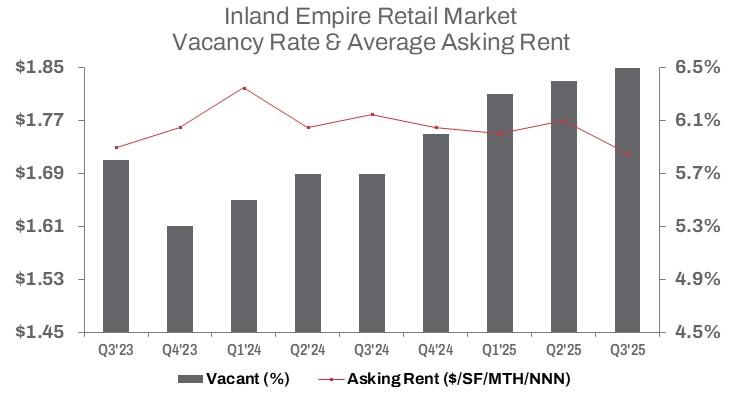
The total retail space vacancy rate rose modestly to 6.5 percent in Q3 2025, up 10 basis points from the previous quarter and 80 basis points from last year. This increase reflects 192,255 square feet of new inventory delivered during the period, while net absorption totaled negative 36,372 square feet, slightly down from negative 28,046 square feet in the prior quarter. Year-to-date net absorption stands at negative 263,997 square feet as the market navigates retailer bankruptcies and downsizing. The Airport submarket led the region in negative net absorption, primarily due to weaker leasing activity.
Leasing volume remained subdued as tenants reassessed expansion plans amid higher operating costs and broader economic uncertainty. Year-to-date leasing volume dropped 15.2 percent compared with last year. Smaller-format retailers, service-based tenants, and experiential retail accounted for the bulk of new leases. Average net asking rents fell modestly, down 2.8 percent quarter over quarter to approximately $1.72 per square foot per month triple net and down 3.4 percent year over year. Sublease availability continues to influence the market, a bright spot as it has declined 18.0 percent quarter over quarter and 29.1 percent year over year as excess space is absorbed.
Retail investment sales normalized in Q3 2025, totaling $200 million, a 26.5 percent decline from the elevated Q2 volume, which included a large portfolio transaction. Year-to-date total sale volume is up 3.2 percent from last year, reflecting stronger early-year activity. The slowdown reflects reduced deal size and increasingly selective investor behavior. The average sale price reached $314 per square foot, up 7.3 percent year over year.
Construction activity continued in Q3 2025, with 761,070 square feet of new retail space under development, down 18.4 percent from the previous quarter and 4.4 percent year over year. Developers remain optimistic about long-term demand supported by steady population growth and rising consumer spending, but are proceeding cautiously due to elevated interest rates, tighter lending conditions, and evolving retailer demand.
TRENDS TO WATCH
The repurposing of big-box properties is expected to continue, demonstrating the market’s adaptability. Closures of national chains, including Rite Aid and the recent wave of 99 Cents Only vacancies, remained significant, yet they also created highly desirable opportunities for expansion-minded tenants. The successful absorption of these large-format spaces by diverse users is a key indicator of market resilience.
This shift is increasingly defined by non-traditional anchors filling big boxes. Rancho Belago Childcare is set to occupy a 73,370-square-foot space in Riverside, and Crunch Fitness secured 31,000 square feet at Jurupa Spectrum Center. Demand for high-traffic, prominent locations remains strong, particularly within the booming experiential sector. Launch Family Entertainment is entering the market with its first California location, a 35,292-square-foot venue at Temecula Town Center. Airtopia is opening an adventure park at Highland Avenue Plaza, and Funbox is set to open a 17,060-square-foot indoor bounce park in Riverside.
Beyond entertainment, the grocery and value-oriented sectors continue to drive steady absorption. Sprouts Farmers Market executed two significant leases: a 23,299-square-foot space at Jurupa Spectrum Center and a 23,256-square-foot build-to-suit location in Apple Valley. HomeGoods leased 22,378 square feet at Upland Center, and Dollar Tree leased a 31,000-square-foot former 99 Cents Only location in Victorville.
Despite moderate fluctuations in availability this quarter, Inland Empire’s retail fundamentals remain comparatively healthy over the long term. Limited new supply and resilient consumer spending continue to support gradual market stability. Looking ahead, success will depend on strategic repositioning and adaptive reuse as the region’s retail landscape evolves to meet changing consumer habits.