Shifting Sentiment and the Lasting Premium on Asset Quality
What a Well-Timed Arcadia Office Sale Tells Us About Today’s Investment Market
A conversation with Marie Taylor, Executive Vice President, Investment Services Group
Buyer sentiment, cap rate pressure, and the rising value of lease stability are redefining how investors approach today’s market.
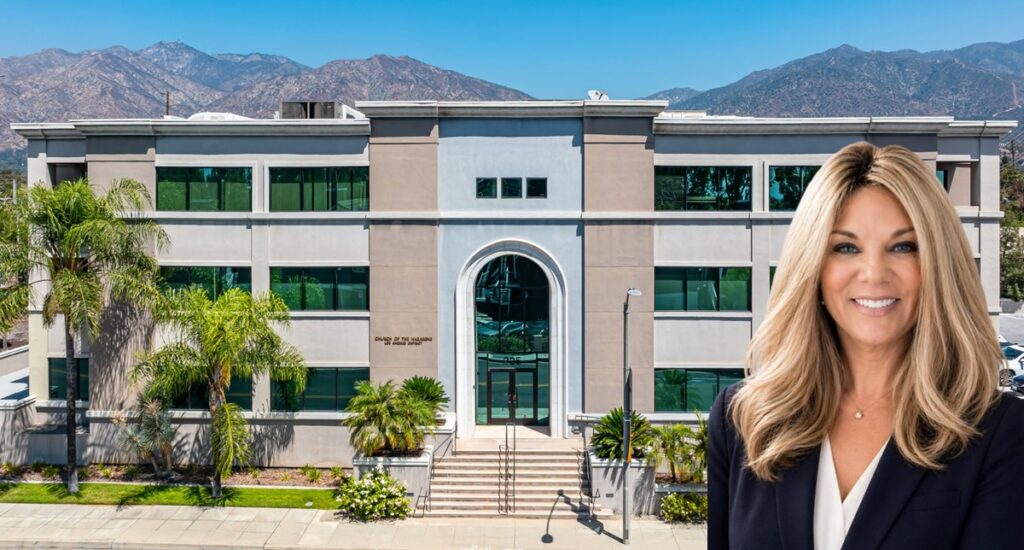
A recent lease renewal and last year’s sale tell a connected story about how the market has shifted. Just over a year ago, the Church of the Nazarene sold its fully leased 21,673-square-foot office building at 225 E. Santa Clara Street in Arcadia for $7.4 million, or approximately $341 per square foot, at a 5.27% cap rate. Marie Taylor, Executive Vice President in our Investment Services Group’s Pasadena office, represented the Church of the Nazarene in the sale. Marie recently represented the organization again, this time as landlord on a lease renewal for another one of their assets. It is the kind of ongoing trust that gives a broker a rare, long view of how deals age. I caught up with her via email while she was traveling to get her perspective on the sale and what it tells us about where the investment market is heading.
Looking back, the timing worked out well for the seller.
| Sale Price
$7.4M
|
Price per SF
$341
|
Cap Rate
5.27%
|
| 225 E. Santa Clara St | 21,673 SF 100% leased | Stabilized Tenancy |
“While interest rates and cap rates have not shifted dramatically enough on paper to completely redefine valuations, buyer sentiment has softened noticeably over the past year. In addition, several tenant leases within the building were approaching renewal windows over the next 12 to 18 months, which likely would have created additional hesitation among buyers today. Selling while the asset was fully stabilized, highly occupied, and supported by strong remaining lease term proved advantageous.”
The transaction ultimately attracted a hybrid owner-user and investment buyer, a profile that played a decisive role in the outcome.
“The ultimate buyer occupied approximately 3,500 square feet of the building, which became a major driver in the transaction. At the time of sale, pure investment buyers were already cautious at that pricing level. In today’s environment, with lower overall market confidence and more conservative underwriting, I do not believe the property would have achieved the same pricing. That said, this was not purely an investment acquisition. It was a hybrid owner-user/investment purchase, which created value beyond the income stream alone.”
When asked whether the buyer secured a rare opportunity or the seller exited at the peak, Marie did not hesitate.
“Honestly, both. The seller exited at an excellent time. The building was fully stabilized with seasoned tenants, strong remaining lease term, and virtually no deferred maintenance, all at a point when buyer confidence was beginning to soften. At the same time, opportunities like this are exceptionally rare in Arcadia. Whether you are looking for a 5,000-square-foot building, a 25,000-square-foot building, or anything in between, it is extremely difficult to find a turnkey office asset of this quality in Arcadia.”
Across the San Gabriel Valley, Marie is watching a clear divide form between high-quality assets and everything else.
“Office cap rates in the San Gabriel Valley have generally trended upward over the past 12 months, although the market has not moved uniformly across all product types or locations. High-quality, well-leased assets in strong suburban markets such as Pasadena and Arcadia continue to attract investor demand, while properties with deferred maintenance, weaker tenancy, functional obsolescence, or near-term lease rollover have experienced greater pricing pressure.”
Buyer underwriting has also shifted in ways that go beyond interest rates, and Marie points to where she sees the market rewarding quality most clearly.
“Buyer underwriting has become noticeably more conservative. Investors today are placing far greater emphasis on tenant stability, remaining lease term, location quality, walkability, surrounding amenities, and overall asset condition. We are also seeing many secondary suburban office markets outperform larger urban cores, as tenants increasingly prioritize convenience, safety, and proximity to where ownership and employees live. That dynamic is one of the reasons markets like Pasadena have generally outperformed Downtown Los Angeles.”
For owners weighing whether to hold or sell, Marie offers a practical framework that starts with understanding who your most likely buyer is.
“If the property has strong owner-user potential, it is often advantageous to allow leases to naturally expire and position the building for an owner-user sale within approximately a year of the final lease expiration. Owner-user buyers can frequently justify stronger pricing than pure investors. If ownership intends to sell immediately, however, stabilizing the asset through lease renewals becomes critical. Renewing tenants, extending weighted average lease term, and minimizing vacancy exposure generally creates a stronger investment narrative and broader buyer pool.”
On the question of whether early lease renewals can offset cap rate pressure, Marie is direct.
“Early lease renewals are extremely important in today’s market. Cap rates are influenced not only by interest rates, but also by tenant quality, lease stability, location, and overall property condition. What has changed more significantly is buyer underwriting and risk tolerance. Cap rates have expanded, and sellers need to recognize that adjustment. Strong tenant commitment and long-term lease stability can absolutely help offset some of that pressure by creating predictability and reducing perceived risk.”
Marie also shared what drove the Church of the Nazarene’s decision to sell, and what she is seeing more broadly among nonprofits and religious organizations holding real estate.
“In this particular situation, the primary issue was operational. The nonprofit organization was understaffed and did not have the infrastructure or experience necessary to actively manage a multi-tenant investment asset long term. Although the property had been transformed into one of the premier office buildings in Arcadia and remained nearly fully leased for many years, ownership ultimately determined that active property management was outside their core mission. More broadly, I have seen a growing number of religious and nonprofit organizations evaluating the sale of assembly properties as membership trends continue to evolve.”
The takeaway from this transaction is straightforward: quality, stability, and timing still win.
Marie and our Investment Services Group remain valuable resources for clients navigating today’s investment market. Don’t hesitate to reach out to her directly if she can be of assistance, and connect with Marie on LinkedIn for more market insights.