South Bay CRE Is Repricing as SpaceX Raises the Region’s Profile
LA’s South Bay CRE Market Is Entering Its Next Phase
Investment activity is becoming more selective as aerospace and technology reshape demand across the region.
SpaceX May Be the Catalyst. The South Bay CRE Market Is Already Showing the Shift.
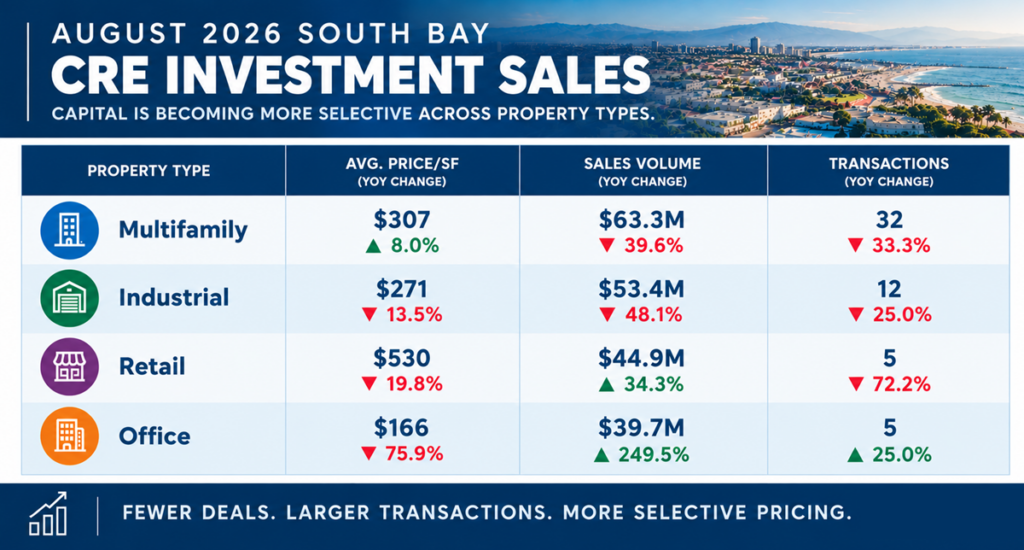
Nearly three months after examining what SpaceX’s historic IPO valuation could mean for LA’s South Bay commercial real estate, August investment sales data offers an early look at how the market is responding.
The numbers don’t yet tell a story of a broad-based investment surge. They tell something more interesting: capital is becoming more selective.
In August, multifamily transactions declined 33.3%, yet average pricing increased 8.0% to $307 per square foot. Industrial transactions fell 25% year over year, while sales volume declined 48.1% and average pricing fell 13.5% to $271 per square foot. Retail transactions plunged 72.2%, but dollar volume increased 34.3% as larger properties traded. Office sales volume jumped 249.5%, although the increase was driven by significantly larger assets changing hands at substantially lower prices per square foot.
Yet pricing moved in the opposite direction. Average price per square foot increased 8.0% to $307, while asking rents rose 1.5% to $2,092 per unit.
The two-year comparison is more striking. Sales volume is down 59.7% from August 2024, while average pricing has declined 35.8% from $479 to $307 per square foot. At the same time, vacancy has remained relatively tight, moving from 4.0% in August 2024 to 4.4% today, while asking rents have increased 2.5%.
That suggests the investment pricing reset is being driven more by higher borrowing costs and investor expectations than by a deterioration in operating fundamentals.
In other words, fewer multifamily properties are trading, but the assets that are changing hands are still commanding relatively strong per-square-foot pricing.
That could become increasingly important as SpaceX draws greater investor attention and capital into the South Bay, raising the profile of the region and potentially increasing demand for housing.
Vacancy increased 40 basis points from 6.6% a year earlier to 7.0%, while asking rents declined 2.0% to $1.46 per square foot. The changes are modest, but they point to a market with more available space and greater pricing discipline.
The two-year comparison tells a different story on investment activity. Industrial transactions are up 50% from August 2024, while sales volume has increased 193.1%. Yet average pricing remains essentially unchanged at $271 per square foot.
That is an important distinction. More capital is moving through the industrial market, but it has not translated into broad-based price appreciation.
The market appears to be recalibrating valuations around today’s cost of capital, even as the South Bay’s aerospace, defense and logistics ecosystem continues to support long-term demand.
SpaceX can create additional demand for the South Bay’s industrial ecosystem without necessarily pushing industrial values higher.
The reason was size. The average transaction jumped from $2.2 million to nearly $9.0 million, while average building size increased from 4,360 square feet to 16,935 square feet.
At the same time, average pricing declined 19.8% to $530 per square foot.
Vacancy edged up 20 basis points to 6.6% in August 2026 from 6.4% a year earlier, essentially unchanged from a year ago. Given the thin transaction sample this year, the modest increase is not a meaningful signal of changing retail demand.
The takeaway isn’t that retail demand suddenly surged. A small number of larger transactions drove the increase in investment volume while pricing remained under pressure.
The properties involved were dramatically larger than those that traded a year earlier. Average building size increased from 4,858 square feet to nearly 110,000 square feet, while average price per building square foot fell 75.9% to $166 per square foot.
The two-year comparison adds important context. Office vacancy was 15.3% in August 2024 and stands at 15.4% today, essentially unchanged. Asking rents, however, have declined 5.0%, from $3.18 to $3.02 per square foot.
So while office investment activity has increased, the operating picture remains challenging. More importantly, the scale of the properties changing hands has increased dramatically, suggesting investors are willing to transact on larger assets when pricing reflects current market conditions.
The message is clear: office capital is moving, but investors remain highly selective about the assets and pricing they are willing to pursue.
That distinction matters as the region prepares for what could be a significant new source of economic activity from SpaceX and the broader aerospace and technology ecosystem.
SpaceX doesn’t have to directly generate every transaction to affect South Bay CRE. Its growing scale and visibility can attract the capital, companies and talent that create the next wave of demand.
The question isn’t whether SpaceX will transform the South Bay overnight. It’s where that economic impact will show up first in commercial real estate.
The South Bay has something Silicon Beach didn’t have at the beginning of its transformation: an established aerospace ecosystem, a deep industrial base, immediate access to LAX, the ports of Los Angeles and Long Beach, and a growing defense presence.
SpaceX may be the catalyst, but it won’t be the entire story.
The bigger story is how the South Bay converts aerospace growth, investment and economic activity into real estate demand.