Fourth Quarter 2025
Retail Recovery Continues in Ventura County as Vacancy Tightens
Q4 occupancy gains and strong sales activity highlighted progress, despite slower leasing and ongoing tenant turnover.
As vacancies decline and investors return, competition for well-located space remains active across the county.
MARKET OVERVIEW
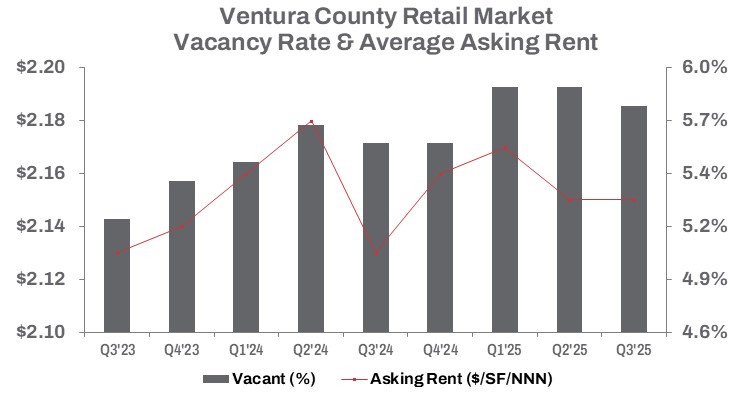
Ventura County’s retail market continued its gradual recovery in Q4 2025, approaching nearly six years since the pandemic began. Vacancy declined to 5.5 percent, down 30 basis points from the prior quarter and 10 basis points year over year. Leasing volume fell 27.0 percent quarter over quarter, though year-to-date activity reached 949,941 square feet, up 34.6 percent from 2024. Even with a slow fourth quarter, the year-to-date activity finished significantly ahead of 2024 levels, as the Q4 dip was not enough to erase the year’s substantial gains.
Retail bankruptcies in 2025 shuttered several prominent chains, but many tenants moved quickly to backfill well-located vacancies. Net absorption totaled 96,882 square feet in Q4, pushing occupancy 131,518 square feet above year-end 2024 levels. Total vacant space declined from its mid-2025 peak to 2.4 million square feet by year-end. While this marks steady progress, vacancy remains above pre-pandemic norms.
Modest occupancy gains kept landlords focused on retention and lease-up strategies. Concessions remained common, while asking rents held steady. Some owners opted to sell rather than carry prolonged holding costs such as taxes, insurance, maintenance, and interest. The average retail sale price reached $312 per square foot, reflecting stabilization following earlier volatility.
Sales activity accelerated sharply in Q4, rising 91.4 percent quarter over quarter, with more than 1.5 million square feet trading. Even with the late-year surge, total square footage sold in 2025 remained 37.1 percent below 2024 levels. A major contributor to Q4 volume was the sale of a 1.86-million-square-foot portfolio of 10 grocery-anchored centers by Merlone Geier Management to a joint venture between DLC Management Corporation and a fund managed by DRA Advisors for $625 million, or about $335.86 per square foot. The portfolio included Mountaingate Plaza in Simi Valley, totaling 285,383 square feet.
Average asking rents for direct space remained essentially flat at $2.15 per square foot, triple net, up just one cent from the prior quarter and unchanged year over year. While sales surged late in the year, leasing activity softened in Q4. Ultimately, however, the strong momentum established earlier in 2025 pushed annual totals to nearly 1 million square feet—solidifying a 34 percent increase over the previous year.
TRENDS TO WATCH
Retail conditions across Ventura County continue to shift into a phase of calculated adjustment. Landlords are expected to keep fine-tuning asking rents and offering concessions to stabilize cash flow and backfill vacancies, particularly in larger second-generation spaces where downtime remains longer. The quick-service restaurant segment is also entering a selective contraction cycle. Yum! Brands plans to close roughly 250 underperforming Pizza Hut locations nationwide in the first half of 2026. Even so, the brand maintains a sizable footprint in California, with about 500 locations statewide and seven in Ventura County across Oxnard (3), Thousand Oaks (2), Simi Valley (1), and Westlake Village (1). As some retailers scale back, others are stepping into well-located vacancies, creating a churn that continues to reshape tenant mixes and reposition shopping centers.
As investors look for long-term yield, recent year-end investment activity highlights how investors are responding to this environment. In one notable transaction, Kampar Corporation sold an 81,129-square-foot grocery-anchored center to Rhino Investments and a private buyer for $20.33 million, or about $250.53 per square foot. The property traded after roughly six months on the market at a discount from its $22.74 million initial ask. It was 95 percent leased at closing and anchored by La Plaza Meat Market, with about 70 percent of shop tenants in place since at least 2018. Reported 2025 net operating income of $1,591,855 reflected an in-place cap rate of 7.83 percent, underscoring investor appetite for stable, income-producing centers with established tenancy.
Another sale involved JH Real Estate Partners, Inc., which sold a three-building, 76,060-square-foot shopping center to 4D Development for $31.8 million, or $418 per square foot. The property was marketed from late June through October 2025 with an initial asking price of $33.7 million. It was 98 percent occupied at the time of sale and anchored by a Vons that has operated at the site since 1984. Approximately 76 percent of the GLA has been occupied for more than 13 years, reinforcing the value investors continue to place on long-tenured grocery-anchored assets. Smaller single-tenant and freestanding properties are also trading. Late in the fourth quarter, a private buyer acquired a 14,715-square-foot freestanding retail property at 2303 E. Vineyard Avenue for $4.05 million, or $275 per square foot. The building had been leased to Walgreens through 2024 before the company announced plans to close roughly 1,200 stores nationwide over three years. Transactions like this illustrate how vacated drugstore boxes, while challenging to re-tenant, can attract investors willing to reposition or backfill well-located sites.
Looking ahead, landlords are expected to continue offering incentives to attract tenants, while expanding retailers pursue strong trade-area locations. Investor interest remains focused on stabilized centers and properties with repositioning potential. Retail bankruptcies and shifting consumer patterns will continue to create both headwinds and openings. Competition for prime space is likely to stay active, and volatility may rise as tenants and owners compete for well-positioned assets. Together, these dynamics suggest that Ventura County’s retail market is not retreating but evolving, with repositioning and selective expansion shaping the next phase of recovery.